
Conectado

Conectado, a video game to raise awareness about bullying and cyberbullying at school

Conectado is a graphic adventure where the player puts himself in the situation of a person who suffers bullying on a daily basis in his school. In Online the player goes through 5 days, where he has to start in a new high school and make friends. Over the course of the days, the teammates he knows will turn their backs on him and interfere with him, both in person and through social networks. In this way, the player, in a safe way, experiences what it means to be a victim of bullying and cyberbullying. The video game reflects the most common aggressions such as social exclusion, insults, nicknames, publication of images retouched to humiliate and laugh at a person, offensive messages, theft of passwords and material objects, blackmail, and so on. This is intended to increase the empathy of the players towards the victims, as well as to make them reflect on the final consequences of some of these acts by increasing their awareness.
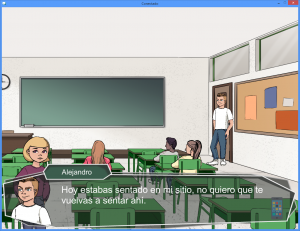
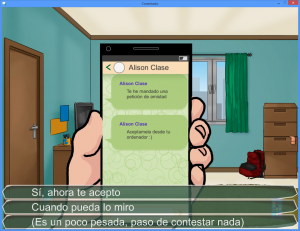
The video game allows working with feelings and empathy and confronts the student with feelings such as helplessness, inferiority, frustration and loneliness through several minigames in the form of nightmares. In these mini-games the player cannot win to increase those feelings. In addition, through the numerous dialogues of the game the player can respond in different ways to decrease the confrontation but never reaches a complete solution of the problem until the end of the game (nor responding violently). In this way it is transmitted to the player that the way to combat bullying and cyberbullying is to ask for help. The main idea is that cyberbullying is a serious social problem that cannot be solved by the player alone.

Conectado has been designed and developed with the teacher’s use in class in mind. It has a duration of about 40 minutes, being perfectly possible its incorporation in an hour of class and giving time to a small discussion guided by the tutor or teacher on the experience that the players live through the videogame. This common experience lived by the students allows the teacher to carry out a reflection session where the students talk and discuss the situation lived within the video game (and in which the educator can raise discussions about whether any of these situations occur in the school and how their students live it). Some of the interactions with the characters as well as with the social network or mobile phone present within the game are simplified, being limited representations of the real systems.


Currently the game has been tested by 85 teachers, +120 education science students and +1000 young people aged 12 to 17.

If you have any questions or want us to go with the video game Conectado to your center do not hesitate to write to the following email address:

[email protected]

Related publications

Cristina Alonso-Fernández, Antonio Calvo-Morata, Manuel Freire, Iván Martínez-Ortiz, Baltasar Fernández-Manjón (2023): Evidence-based evaluation of a serious game to increase bullying awareness. Interactive Learning Environments, 2020. [JCR 2020, Impact Factor: 3.928, Q1, 43/264 in EDUCATION & EDUCATIONAL RESEARCH]. DOI: 10.1080/10494820.2020.1799031.

Antonio Calvo-Morata, Baltasar Fernández-Manjón (2023): Serious Games for Social Problems. 21st International Conference on Web-Based Learning, ICWL 2022, and 7th International Symposium on Emerging Technologies for Education, SETE 2022, Tenerife, Spain, November 21–23, 2022, DOI: 10.1007/978-3-031-33023-0_9.

Antonio Calvo-Morata, Cristina Alonso-Fernández, Manuel Freire, Iván Martínez-Ortiz, Baltasar Fernández-Manjón (2021): Creating awareness on bullying and cyberbullying among young people: Validating the effectiveness and design of the serious game Conectado. Telematics and Informatics, Volume 60, July 2021, [JCR 2020 IF 6.182, 11/86, Q1 in INFORMATION SCIENCE & LIBRARY SCIENCE]. DOI: 10.1016/j.tele.2021.101568.

Antonio Calvo-Morata, Cristina Alonso-Fernández, Manuel Freire, Iván Martínez-Ortiz, Baltasar Fernández-Manjón (2020): Serious games to prevent and detect bullying and cyberbullying: a systematic serious games and literature review. Computers & Education, Volume 157, November 2020, [2019 IF 5.296 JCR, Q1 in COMPUTER SCIENCE, INTERDISCIPLINARY APPLICATIONS]. DOI: 10.1016/j.compedu.2020.103958.

Antonio Calvo-Morata (2020): Uso de Técnicas de Learning Analytics para la Validación, Mejora y Aplicación de Juegos Serios en la Clase Aplicado al Ciberbullying. Tesis doctoral. Noviembre 2020. Universidad Complutense de Madrid.

Antonio Calvo-Morata, Concha García-Diego, Manuel Freire, Iván Martínez-Ortiz, Baltasar Fernández-Manjón (2019): Conectado in the classroom: applying a video game for the prevention of bullying at the school. 12th annual International Conference of Education, Research and Innovation (ICERI 2019), 11th – 13th November, 2019, Seville (Spain).

Antonio Calvo-Morata, Manuel Freire, Iván Martínez-Ortiz, Baltasar Fernández-Manjón (2019): Applicability of a cyberbullying videogame as a teacher tool: comparing teachers and educational sciences students. IEEE Access (in press), DOI: 10.1109/ACCESS.2019.2913573 [Q1 IF 3.557 JCR].

Antonio Calvo-Morata, Dan-Cristian Rotaru, Cristina Alonso-Fernandez, Manuel Freire, Iván Martínez-Ortiz, Baltasar Fernández-Manjón (2018): Validation of a Cyberbullying Serious Game Using Game Analytics. IEEE Transactions on Learning Technologies (in press), DOI: 10.1109/TLT.2018.2879354 [IF 1,869 JCR].

Antonio Calvo-Morata, Manuel Freire, Iván Martínez-Ortiz, Baltasar Fernández-Manjón (2018): Conectado: A Serious Game to Raise Awareness of Bullying and Cyberbullying in High Schools. Educational Communications and Technology, Issue 3, 2018, pages 59 to 64 (original published in Chinese).

Antonio Calvo-Morata (2017): Videojuegos como Herramienta Educativa en la Escuela: Concienciando sobre el Ciberbullying. Final Master Thesis. Complutense University of Madrid, Faculty of Informatics.

Antonio Calvo-Morata, Baltasar Fernández-Manjón (2017): Conectado: Concienciando contra el cyberbullying mediante un videojuego educativo. Revista Didáctica, Innovación y Multimedia, núm. 36 .

Acknowledgements

IES Salvador Victoria – Monreal del Campo, Teruel
IES Valdespartera – Zaragoza
Centro La Inmaculada – Madrid
IES Europa – Móstoles, Madrid
IES Marqués de Santillana – Colmenar Viejo, Madrid
Colegio San Jorge – La Alcanya, Murcia
IES Manuel de Falla – Puerto Real, Cádiz
IES Federico Balart – Pliego, Murcia
IES Giner de los Ríos – Alcobendas, Madrid
IES Antonio Machado – Soria
Colegio El Catón – Torrejón de Velasco, Madrid
IES Carpe Diem

Concha García Diego and ESCUNI
Santiago Ortigosa López